My apologies for the lateness of this post, I’ve been a little sidetracked during the last couple days. We’re back though, and we’re ready to dive into the next part of this journey. If you’ve enjoyed the previous posts, you’ll like this one too. Today, I’m going into the actual process of writing jokes. It’s pretty straight-forward, so let’s jump right in.
Your main tool here is free-association. You’ve probably heard of exercises where you write or say anything that comes to mind when given a subject or topic. That’s pretty much what you do here, and you can write the information in any format that suits you best. You can do lists, outlines, or even mind-maps. A book I’ve been reading titled The Serious Guide to Joke Writing recommends using mind-maps, which are my personal favourite writing tool.
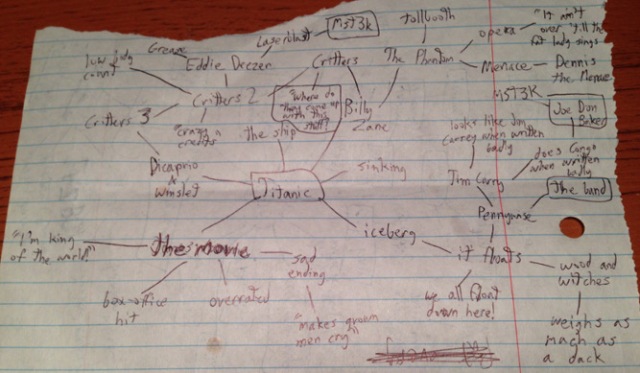
When I say write anything and everything that comes to mind, I do mean just that. Here’s an example of me doing this exercise with the Titanic as the topic.
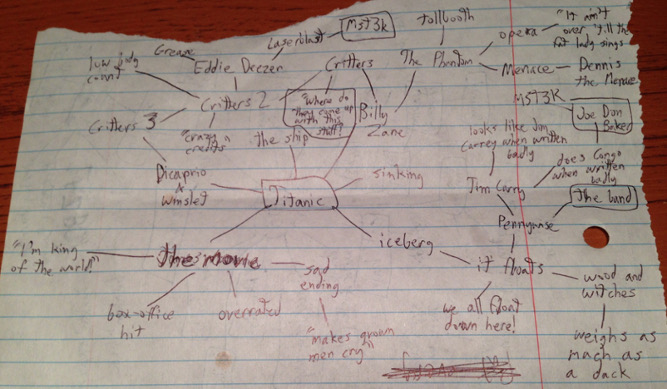
As you can see, a bit of everything comes to mind. Actors from the movie, other films they’ve done, the Titanic itself, etc. Once you write down some free-associations, look at them and free associate from those. If you want to avoid a messy mind-map that might be large, you can write separate mind-maps. Here’s a small one I did on Icebergs.
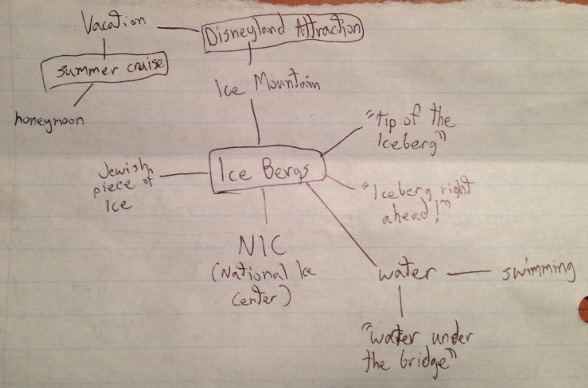
In addition to writing stuff that comes to mind, you can play with the words themselves and write what they make you think of. You can tell in the other mind-map that I really let loose with the free-associations, which is important. Don’t hold back from anything that comes to mind, even if you think it’s silly.
As you write, it’s very likely that ideas for jokes will come to mind, so go ahead and write them. I’ll have a separate clean page of paper nearby where I will write actual jokes as I think of them from the free-associations. Techniques you can apply to get the most out of your material include wordplay, double-entendre, similes, and oxymorons. Go ahead and write the jokes as they generate in your head. Not every sentence has to be a joke, some are simply there to help you transition between ideas. Once again, don’t hold back. You’ll fix everything when you edit & revise.
When revising, just remember that less is more. The more you have to explain a joke, the less funny it will be. Look at other comedian’s jokes and notice how they use words. Also notice how they’ll often play around with common phrases. Revision is a large part, but as you practice you’ll get a feel for it. Here are some of the jokes I got after playing around with ideas.
__________________________________________________
“So I was browsing the internet the other day and learned that the original Dutch word for Iceberg literally translates into Ice Mountain. You know what that means… we’ve found the next big thing for Disneyland!”
“And nevermind building it, let’s bring it over here. Better to do that as opposed to going on a cruise, let’s not forget that one ship that ran into an iceberg problem. I don’t think they blame the iceberg though… some just thought it was an overrated box-office hit.” *
“Ya know, I think we’re a little too bitter towards icebergs, what with the Titanic thing and all. But let’s look at the bright side, they’re handy if we happen to get a black eye at sea.”
“It’s been more than a hundred years since it happened, but I don’t think we should be saying it’s all water under the bridge, ’cause if there were a bridge, none of this would have happened!”
_____________________
So that’s one way you can write jokes. There are others, and while a lot of them are different from one another in some ways, the general idea is always the same. Free-associate, and then work with that. When you do have jokes, you can arrange them in a certain order to form a monologue, which you can learn from Gene Perret’s book along with many other tips on writing jokes. I may give thoughts on that in a later entry, but I’m still learning it myself so I’ll likely wait a while.
With all this said, we have come not to the end of this series, but a good pause for a while. I had a lot of fun sharing what I’ve learned so far and it has gotten me back into practicing, so it’s been exciting. I’ll definitely do other various posts on comedy writing as I learn more, but this should be enough to satisfy anyone’s curiosity. Also, do check out the book I linked to, it has great exercises.
So until next time, keep on writing and always enjoy yourself. Good night everyone! o/
*For the record, I rather enjoyed James Cameron’s Titanic.
 Kasey Lewis - Actor, Writer, Creator
when you come up with the joke idea from the mind map how to do you turn it in to a joke? what are some steps/thought processes you take to get you there?
Apologies for the late response, this is a really good question! For me, it’s all very much part of my thought process. The thought process can be part of the writing process.
As an example, the joke about water under the bridge came about as I was doing the free-association/mindmap technique and questioning everything. Why do these words come to mind? What do I think of when I think of these phrases? “Iceberg right ahead” is from the film, but I thought, “That phrase is already spoofed a lot. What’s something different?” So I went further and took to water itself as a whole other association.
That’s when the phrase, “It’s water under the bridge,” came to mind, and I quickly realized, “Hey it’s a tragic event and people died, you can’t JUST say water under the bridge.” By realizing that, I found that could either be a joke or part of the joke. Then by picturing it and getting theoretical, I questioned, “What if there were a bridge?” So then I realized, “Well if there were a bridge, none of this would’ve happened.”
I also looked at facts and research about the Titanic, mainly the year it happened and how it’s been a long time since. Once I saw that, I knew that’d be a good set-up/lead-in. Facts and research are always a great place to start when writing jokes.
In short, use your thought process by writing it or speaking it out loud, capture it, and use that to your advantage. Let it shape how you connect the words and/or any facts you’ve written. We could even rewrite the joke by getting meta about this process right now, even working in our actions.
“I was on the internet one day and learned the whole Titanic thing happened in 1912. I thought, well that was over a hundred years ago… and most survivors are probably dead… can we just say it’s all water under the bridge? We probably could! Sure, it’s messed up, but we definitely could. Then again, when I think about it… if there were a bridge, none of this would’ve happened.”
Obviously, less is more, and you don’t have to get meta, but when you’re starting the process, it can be helpful to write more than what you need and then chip away at it to make the joke more efficient and to your liking.
Overall this is what works for me. I hope this helps!
Thank you for your reply. this was very helpful to the questions I need to be asking and flow of getting to the joke/idea. really appropriate it.